
ASA/PVC Hollow Tile
ASA synthetic resin tiles have dominated the market as a novel roofing material, playing a significant role in projects ranging from the Beijing Olympics to the urban redevelopment for the Shanghai World Expo, and from large-scale rural construction to the modernization of factory buildings. In the market recently, a new type of ASA/PVC hollow tile has quietly emerged, particularly gaining popularity in some high-humidity and hot climates in Southeast Asia. Below is a brief introduction to ASA/PVC hollow tiles.
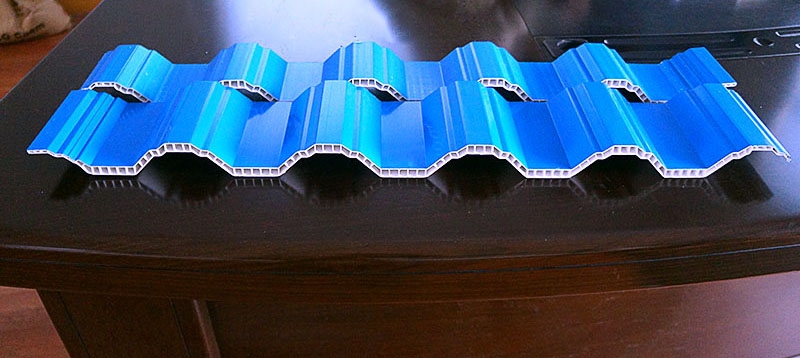
The ASA/PVC hollow tile consists of an upper layer (ASA color co-extrusion material) and a lower layer (PVC with calcium powder filler). The cross-section features a continuous rectangular hollow structure with a high-profile wave design. The thickness is 14mm, width is 850mm, with the upper layer of the tile being 1.4mm, the lower layer 1mm, ribs 0.8mm, wave height 42, and weight 4.7kg/m2. The blue surface layer is co-extruded ASA with a thickness of 0.15mm.
Looking at the design structure of ASA/PVC hollow tiles, compared to ASA synthetic resin tiles, this product has the following characteristics:
- Excellent heat insulation and thermal retention (lower thermal transmission coefficient than 3mm ASA synthetic resin).
- Lighter weight per unit (approximately 20% lighter than 3mm ASA synthetic resin tiles).
- Lower cost (15-20% lower than 3mm ASA synthetic resin tiles, with a formula similar to ASA synthetic resin tiles).
- Better sound insulation (due to the 14mm hollow structure).
- Equivalent weather resistance.
- Comparable initial load resistance.
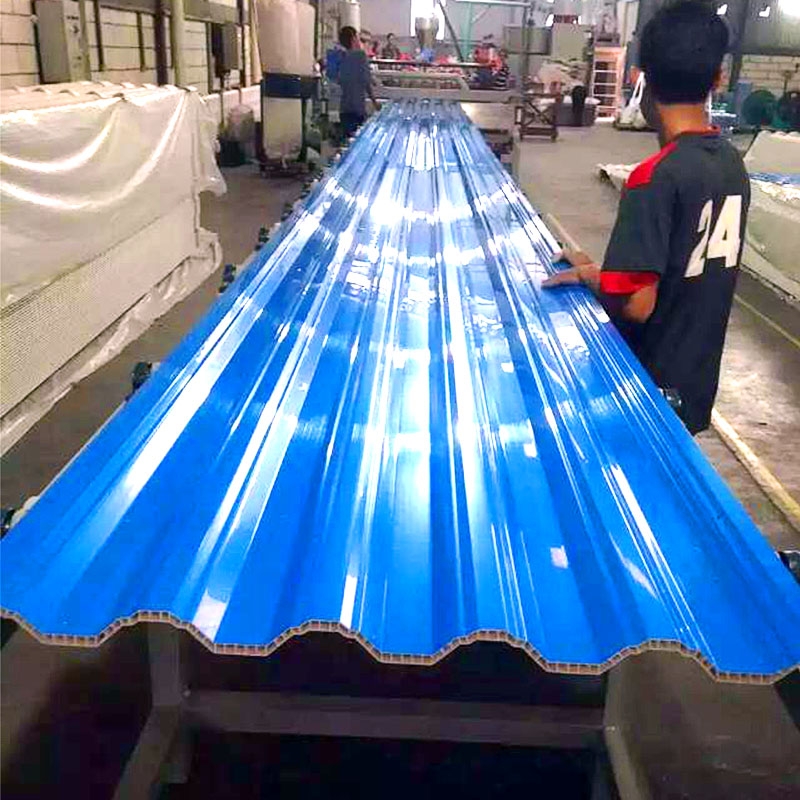
The production equipment for ASA/PVC hollow tiles is the same as that for ASA synthetic resin tiles, using a plastic tile molding machine. However, the extrusion mold is different and includes a vacuum forming section. The structure is simple, and operation is easy. Since the mold and forming sections differ from ASA synthetic resin tiles, with less adjustability, there is a higher demand for the flow properties of ASA color co-extrusion material. Common ASA materials may experience defects such as flow marks, whitening, streaking, and unevenness.


Leave a Reply
Want to join the discussion?Feel free to contribute!